


Content Marketing Funnel for Creators: From Post to Sale

Posting more is not a strategy. A content marketing funnel connects what you publish to sign-ups, emails and sales. Here is how to build one, stage by stage, inside Weesify.
Many creators work incredibly hard at the top of the funnel and leave the rest to luck. They post every day, grow a following, and then wonder why so few people buy the course or book the session. The problem is rarely the content. It is that nothing connects the content to the next step.
A content marketing funnel is that connection. It is the path someone takes from first seeing your post to becoming a subscriber, then a customer, then someone who tells their friends about you. This guide breaks the funnel into five stages and shows how to set up each one inside Weesify, so every piece you publish has somewhere to lead.
In this guide
- The five stages of a creator funnel
- Stage 1: Attract with content
- Stage 2: Capture with a reason to subscribe
- Stage 3: Nurture with email and automations
- Stage 4: Convert with offers that fit
- Stage 5: Keep and grow with community
- Measuring the whole funnel
- FAQ
The five stages of a creator funnel
| Stage | The visitor's question | Your job | Where it lives in Weesify |
|---|---|---|---|
| Attract | "Is this useful to me?" | Publish helpful content consistently | Content OS, Video Studio, Blog |
| Capture | "Do I want more of this?" | Offer a clear reason to subscribe | Pages, Forms, QR codes |
| Nurture | "Can I trust this person?" | Deliver value by email over time | Email, Automations, Contacts |
| Convert | "Is this worth paying for?" | Make a fitting offer | Store, Courses, Bookings, Events |
| Keep | "Am I glad I bought?" | Deliver, thank and connect | Community, Automations |
You do not need every stage perfect on day one. You need each stage to exist, so that people can move forward when they are ready.
Stage 1: Attract with content
This is the stage most creators already know. The aim is not virality; it is being consistently helpful to a specific group of people.
- Plan around pillars. In Content OS, set up your brand profile with content pillars so your mix stays balanced, then plan posts and campaigns on the calendar. See plan, write and publish in one place.
- Make one piece work harder. Turn a long video into short clips, and a lesson into several posts. See repurpose one video into many posts.
- Own some of your content. Social posts fade quickly; blog posts can be found through search for years. See start a blog on Weesify and SEO basics for creators.
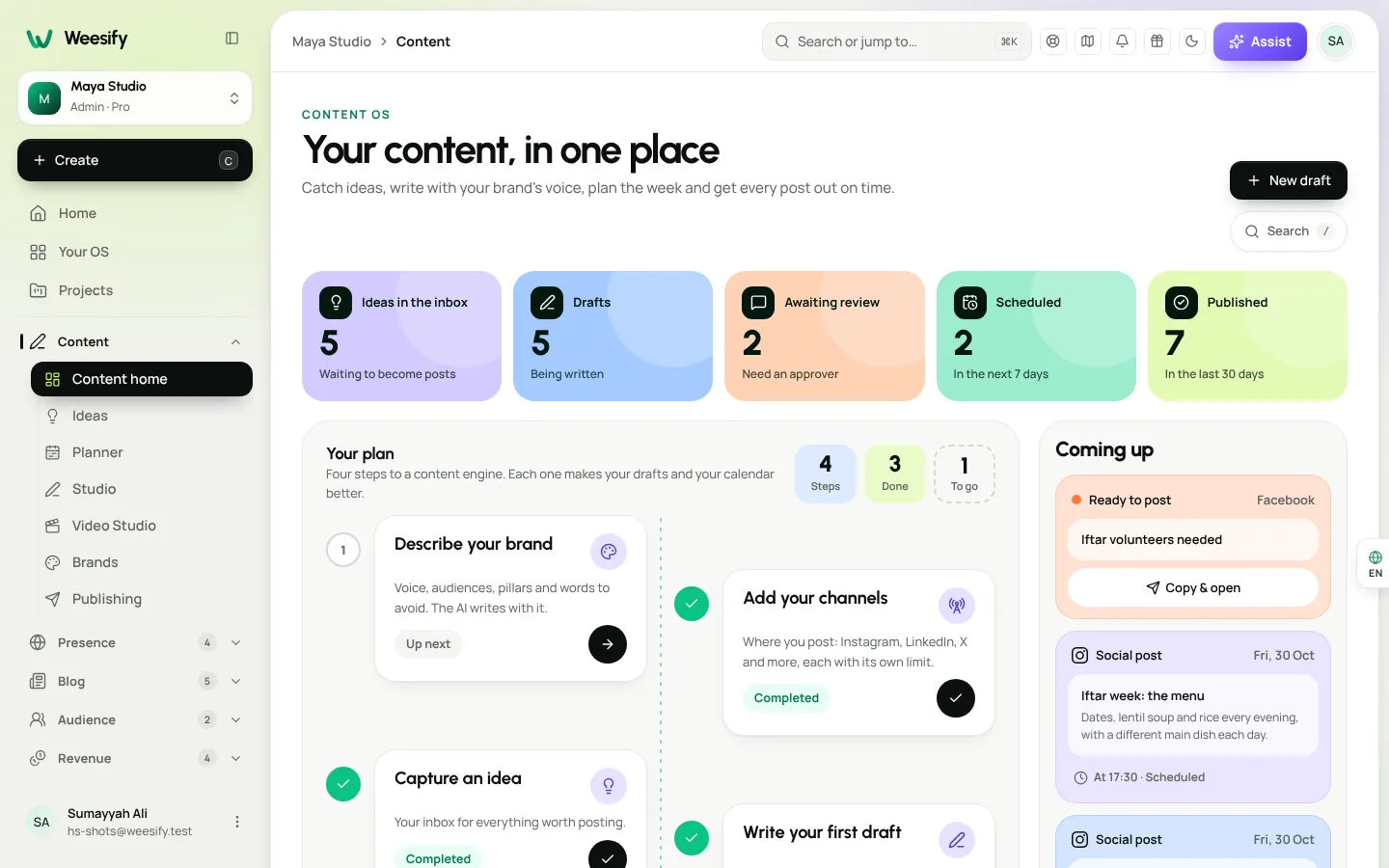
The key move at this stage: every piece of content should point somewhere. A post ends with "the full checklist is free on my page", a video description links to your sign-up form, a blog post has a form block at the end.
Stage 2: Capture with a reason to subscribe
Followers belong to the platform. Subscribers are people you can reach directly. The capture stage turns one into the other.
Give a specific reason
"Subscribe to my newsletter" is weak. "Get the 7-day Arabic reading plan" is strong. A good lead magnet is small, specific and immediately useful: a checklist, a short email course, a template, a recorded lesson.
Build the capture form
In Audience › Forms, create a form with an Email question, an optional Email consent question, and Tag everyone who answers set to the lead magnet's name. Use Move new people to stage to mark them as a Lead if appropriate. The lead capture forms guide covers every setting.
Put it everywhere
- On your link-in-bio page, with the Form block near the top.
- Behind a branded short link you can say out loud in a video.
- On a one-click form QR code for talks, classes and events.
Every answer lands in Contacts, with the source recorded and consent handled the way the person chose.
Stage 3: Nurture with email and automations
This is the stage most creators skip, and it is where trust is built. Someone who just downloaded your checklist is curious, not committed. A few good emails change that.
Automate the first week
In Engagement › Automations, start from Welcome new subscribers or trigger on A tag is added for your lead magnet tag. Deliver the promised resource, wait two days, send your best piece of content, then share your story. The welcome sequence guide has a ready-made structure.
Keep a steady newsletter
A weekly or fortnightly broadcast keeps you present without demanding attention. Teach something, share something, and occasionally mention your offer. See email newsletters that get read.
Know who is who
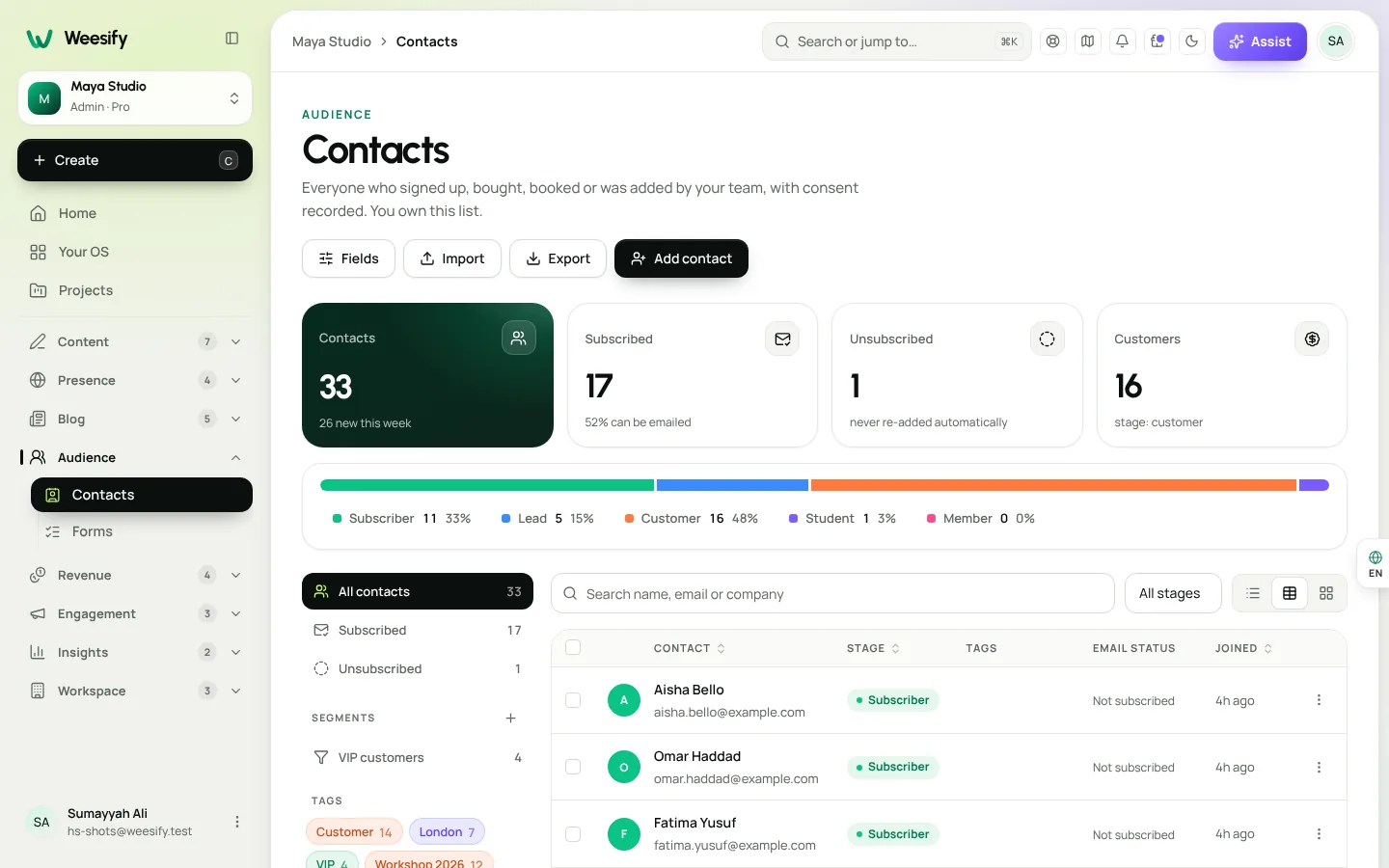
Use Contacts to see each person's timeline: the forms they filled in, what they bought, the emails they received. Segments such as "Leads who joined this month" or "Tagged: Arabic reading checklist" let you send the right message to the right group.
Stage 4: Convert with offers that fit
By now, people know you and trust your work. The offer should feel like the natural next step, not a sudden pitch.
Match the offer to the stage of your audience:
- A low-price digital product, such as a workbook or template pack, as a first purchase. See sell digital products.
- An online course for people who want a structured path. See launch an online course.
- One-to-one sessions for people who want personal help. See booking pages for consultants.
- Events and workshops for people who learn best live. See host and sell event tickets.
Make the offer to the right segment. People tagged with your Arabic reading checklist are a better audience for your Arabic course than your entire list. An Event card or Product card in a broadcast shows the offer with a clear button.
A time-limited discount code for subscribers can help people who were already leaning towards buying.
Stage 5: Keep and grow with community
The funnel does not end at the sale. A happy customer is the best source of new customers.
- Thank every buyer automatically. The Thank new customers recipe sends a thank-you after a purchase, then asks how it is going.
- Give them a place to belong. A community where customers help each other increases the value of what they bought. See build a paid community.
- Invite them to the next step. Students who finish a course can be welcomed into an advanced course or a mastermind. Trigger an automation on Someone finishes a course to make that invitation at exactly the right moment.
Measuring the whole funnel
Open Insights › Analytics to see how people move through the stages:
- Channels and Sources show which content and platforms attract visitors.
- The Funnel tab follows visitors from a view to a click to leaving their details.
- Leads shows which channels and countries bring the people who sign up.
- From visit to sale follows visitors on a chosen page step by step to a sign-up or purchase.
Add UTM tags to the links in your posts and newsletters, and you can compare campaigns directly. The analytics guide explains each report.
Then fix the weakest stage first. If lots of people visit but few sign up, improve your lead magnet and form. If many subscribe but few buy, look at your nurture emails and your offer. One improvement at the narrowest point usually beats ten improvements at the top.
A simple funnel to build this month
- Pick one lead magnet your audience already asks about.
- Build a form for it and put it on your bio page.
- Write a three-email welcome automation.
- Mention the lead magnet at the end of every post for four weeks.
- Make one fitting offer to the people who joined.
- Check Analytics weekly and fix the biggest drop.
Seasonal campaigns slot neatly into this structure too. See how in growing your audience with a Ramadan campaign.
FAQ
What is a content marketing funnel? It is the path someone takes from discovering your content to subscribing, buying and staying with you. Each stage has its own job: attract, capture, nurture, convert and keep.
Do I need a big audience to build a funnel? No. A funnel helps a small audience convert better. It is often more valuable when your following is small, because every subscriber counts.
How many emails should I send before making an offer? A short welcome sequence of three or four emails that delivers real value is usually enough before a gentle offer. Keep offers occasional in your regular newsletter.
Which stage should I fix first? The stage with the biggest drop. Check the Funnel and Leads tabs in Analytics to find it.
Can I run the whole funnel in one place? Yes. Content, pages, forms, contacts, email, automations, store, courses, bookings, events, community and analytics all live in the same Weesify workspace.
Connect the dots
Content earns attention. A funnel turns attention into relationships, and relationships into a sustainable business. Build each stage simply, connect them, and improve the narrowest point first.
Start your 14-day trial and build your first content marketing funnel this month.
Keep reading
 Growth & marketing
AI Content Ideas That Sound Like Your Brand, Not a Robot
Generic AI ideas produce generic posts. Describe your brand voice once in Weesify and every idea, angle and draft starts closer to how you actually speak.
 Growth & marketing
Captions, Highlights and Short Clips From One Long Video
One long talk can feed your short-video channels for weeks. Here is how to find the strongest moments, add captions people can read on mute, and export clips for every feed.
 Growth & marketing
Discount Codes and Offers That Sell Without Cheapening
Discounts can fill a launch or quietly train buyers to wait for a sale. Here's how to use Weesify discount codes, automatic sales, event codes and order bumps with intent.
Comments
No comments yet. Start the conversation.